An on-call handoff is the moment operational responsibility moves from one human to another. The calendar part is easy: at 10:00, Alice stops being primary and Bob becomes primary. The dangerous part is everything the calendar does not know.
Maybe a database replica is rebuilding. Maybe a deploy was rolled back but error rates are still suspicious. Maybe an alert is acknowledged, a silence expires in 20 minutes and a vendor has promised an update "soon", the internationally recognized unit of time for not soon enough.
A good handoff transfers three things:
- Coverage ownership: who receives new alerts after the boundary.
- Incident ownership: who is responsible for incidents already open.
- Operational context: what is unusual, what may get worse and what the next responder should do.
If you transfer only the pager, the incoming engineer begins the shift with a perfectly accurate schedule and an inaccurate mental model. That is how a harmless warning becomes a 40-minute rediscovery exercise.
First, separate shift ownership from incident ownership
This distinction prevents most boundary arguments. A schedule decides who owns new pages. It does not automatically decide who remains incident commander for a P1 that started 45 minutes earlier.
| Thing | Default owner after handoff | Exception to name explicitly |
|---|---|---|
| New alert after shift start | Incoming on-call | A dedicated incident or maintenance team owns the source. |
| Unacknowledged alert before shift start | Outgoing until accepted by incoming | Your escalation policy has already assigned another responder. |
| Active P1/P2 incident | Current incident commander | There is a deliberate commander transfer with verbal acceptance. |
| Monitoring and follow-up after mitigation | Named owner in the handoff | The incident team retains monitoring responsibility. |
| Planned work during the next shift | Change owner, with incoming on-call informed | The on-call engineer is explicitly assigned as change owner. |
The safest default is: new pages follow the schedule; active incidents keep their current owner until both people agree to transfer them. This avoids a P1 silently changing hands because a cron expression reached the top of the hour.
A handoff is complete when the incoming responder has accepted responsibility, not when the outgoing responder has sent a message.
Use a two-part handoff: generated state plus human judgment
Do not ask the outgoing engineer to manually reconstruct data the system already has. Generate the mechanical inventory and reserve human writing for meaning.
| Generate automatically | Add manually |
|---|---|
| Current and next responder | Why an open item matters |
| Open and acknowledged alerts | What has already been tried |
| Active silences and expiry times | What would make the situation worse |
| Rotation overrides | The next safe action and decision deadline |
| Maintenance windows | Who has the missing context |
| Recent resolved incidents | Why recovery may not be trustworthy yet |
The result should be short enough to scan in two minutes and specific enough to act on. A raw alert export is not a handoff. It is a data landfill with timestamps.
Classify the shift before writing prose
A simple status forces the outgoing responder to make a judgment and tells the incoming responder how much overlap is needed.
| Status | Meaning | Handoff mode |
|---|---|---|
| Green | No active incidents, no unusual risk, normal change calendar. | Asynchronous summary plus explicit acceptance. |
| Yellow | Degradation, risky change, expiring silence, recent recovery or unresolved investigation. | Written summary and a 10-15 minute live overlap. |
| Red | Active P1/P2, unstable mitigation or immediate escalation risk. | Live handoff; incident ownership stays explicit and separate. |
Green does not mean "nothing happened". It means there is no context the next responder must carry. A busy shift can end green after every issue is resolved and verified. A quiet shift can end yellow because a certificate expires in three hours. Silence and safety are not synonyms; monitoring teams learn this repeatedly and with impressive consistency.
Outgoing: "Everything is quiet."
Monitoring: "I have been silenced for six hours."
Incoming: "This meeting has developed a plot."
Run the same timeline every shift
Consistency matters more than ceremony. For a scheduled handoff at 10:00, use a small timeline:
- T-30 minutes: outgoing responder reviews open alerts, recent incidents, silences, overrides, maintenance and upcoming changes.
- T-15 minutes: outgoing responder posts the handoff and marks it green, yellow or red.
- T-10 minutes: incoming responder reads it, checks access and asks questions while the outgoing responder is still available.
- T-5 minutes: yellow or red shifts get a short live call. Screen-share the relevant dashboard, not the entire history of distributed computing.
- T0: incoming responder explicitly writes "accepted". New alert ownership follows the schedule.
- T+10 minutes: if nobody has accepted, trigger the backup path instead of assuming the message was seen.
For follow-the-sun teams, overlap is especially valuable because the outgoing engineer may be asleep by the time a question appears. If regional hours do not overlap, require earlier asynchronous delivery and make the secondary responder available for clarification. Geography does not remove handoff cost; it merely gives the cost a timezone.
The copy-paste handoff template
Keep one template in the team channel or runbook. Delete empty sections only after checking them; empty by default is how "I forgot" dresses up as "not applicable".
ON-CALL HANDOFF
Time: 2026-08-07 10:00 Europe/Berlin
Outgoing: Alice
Incoming: Bob
Shift status: YELLOW
Accepted: pending

ACTIVE INCIDENTS
- INC-184 / checkout latency / P2
  Owner: Alice remains incident commander
  State: mitigated, monitoring until 10:30
  Evidence: p95 is 410 ms, baseline is 250 ms
  Next action: escalate to DB team if p95 exceeds 600 ms for 5 min
  Links: incident / dashboard / runbook

OPEN OR ACKNOWLEDGED ALERTS
- ALT-991 / replica lag / ACK by Alice
  State: lag falling after traffic shift
  Next checkpoint: 10:20

RECENTLY RESOLVED
- INC-181 / worker queue saturation
  Recovery verified for 42 min; may recur during 12:00 batch

CHANGES AND MAINTENANCE
- API deploy at 14:00, owner Carol, rollback tested

SILENCES AND OVERRIDES
- Silence SIL-44 expires 10:25; do not extend without DB lead
- Bob covers Alice until Friday 18:00 via rotation override

DEPENDENCIES / RISKS
- Payment vendor investigating intermittent timeouts
- Search cluster running without one replica until ticket OPS-431

NEXT DECISIONS
- 10:20: review replica lag
- 10:30: close or re-escalate INC-184
- 13:45: pre-deploy check with Carol

INCOMING ACCEPTANCE
- Bob accepted at 09:56; questions resolved in thread
Every open item needs a named owner, current state, next action and decision time. "Keep an eye on the database" is not a next action. It is a tiny curse placed on the incoming engineer.
Handle boundary cases before they happen
An alert fires exactly at handoff
The outgoing responder owns alerts received before acceptance; the incoming responder owns new alerts after acceptance. If both receive the notification, one person writes "I have it" and the other confirms. Never let two people silently assume the other one acknowledged it.
A P1 is still active
Do not transfer incident command merely to make the schedule look tidy. Keep the current incident commander, move new-page coverage to the incoming on-call and assign a relief time. If the commander must transfer, use a live brief: impact, timeline, hypotheses, actions, roles, next decision and explicit acceptance by the new commander.
The incoming responder is unreachable
The outgoing responder does not simply leave the chat after posting. Trigger the secondary or escalation contact, record the coverage gap and keep ownership until someone accepts. This is why a backup path belongs in the rotation design, not in the imagination of the person trying to catch a train.
A silence or maintenance window crosses the boundary
Include the reason, scope, owner and exact expiry time. The incoming responder should know whether to let it expire, remove it early or request approval to extend it. "There is a silence somewhere" is how the next incident becomes performance art.
An acknowledged alert remains open
Acknowledgement means a human took responsibility; it does not mean the condition is fixed. Transfer it like a small incident: include the owner, evidence, what has been tried, the next checkpoint and the escalation trigger.
Map the handoff to IncidentRelay
IncidentRelay already stores much of the mechanical state needed for a handoff:
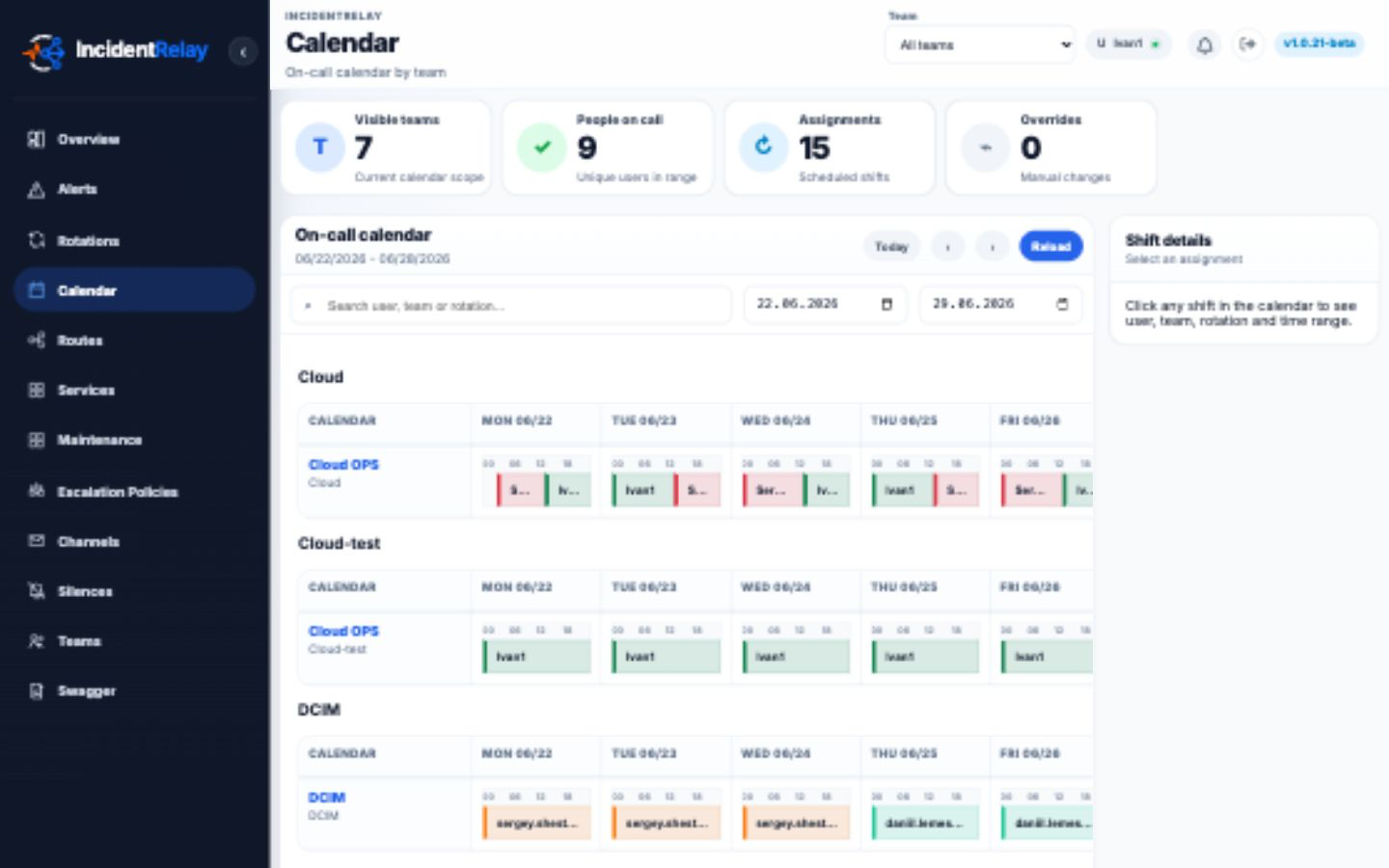
- the rotation and calendar show current and upcoming coverage;
- rotation overrides make temporary swaps visible instead of burying them in chat;
- the alert list shows firing, acknowledged and resolved incidents with timestamps and owners;
- silences expose matcher scope and expiry;
- routes connect services and teams to the calculated on-call responder;
- escalation policies provide the fallback when the incoming responder does not acknowledge.
Use the calendar and alert state as source data, then add the judgment the system cannot infer: why recovery is fragile, which hypothesis is strongest and what evidence should cause escalation. The relationship between teams, rotations and routes is covered in Teams, Rotations, Layers and Routes.
Measure handoff quality without creating a bureaucracy habitat
You do not need a dashboard with 47 panels. Start with a few signals that reveal lost ownership and lost context:
| Metric | What it reveals | Useful review question |
|---|---|---|
| Acceptance before shift start | Whether coverage begins deliberately | Why were late handoffs not escalated? |
| Median handoff length | Whether summaries are usable | Is length caused by real risk or copy-pasted noise? |
| Open items without owner or checkpoint | Ambiguous responsibility | Which template field or automation is missing? |
| Pages to outgoing responder after handoff | Stale routing, unclear ownership or manual subscriptions | Was the schedule wrong or did an old incident retain them? |
| Incidents re-investigated after handoff | Context loss | Which evidence or failed action was not recorded? |
| Escalations in the first 30 minutes | Readiness and boundary risk | Did the incoming responder have access and context? |
Review failed handoffs as system failures, not personality defects. If responders routinely miss a field, improve the template or generate it. If acceptance is late because shifts start during another recurring meeting, change the time. Reliability work is allowed to notice calendars.
Test the process on a boring day
Do not wait for a live outage to discover that the incoming responder cannot open the dashboard. Add a handoff scenario to an on-call game day:
- Create one acknowledged alert and one expiring silence.
- Schedule a temporary override that begins at the handoff boundary.
- Give the outgoing responder incomplete-but-recoverable context.
- Require the incoming responder to accept, identify missing information and state the next decision.
- Fire a second alert five minutes after the boundary and verify the correct responder and escalation path.
Observe whether the team can distinguish new-page ownership from active-incident ownership, find the relevant runbook, inspect the silence and explain who acts next. A passing exercise produces explicit ownership, not merely a message with several green check marks.
The two-minute checklist
- Incoming responder and backup are correct in the schedule.
- Every active incident has a named owner.
- Every open alert has a state, next action and checkpoint.
- Recent recoveries with recurrence risk are listed.
- Upcoming changes, maintenance and external risks are listed.
- Silences and overrides include scope and expiry.
- Yellow and red shifts receive live overlap.
- Incoming responder explicitly accepts the shift.
- No acceptance triggers the secondary or escalation path.
Definition of done
The handoff is done when the schedule names the correct responder, the incoming engineer has explicitly accepted, active incidents retain or deliberately transfer ownership, and every non-green item has an owner, evidence, next action and decision time. The outgoing responder can then disconnect without becoming a hidden dependency.
A five-minute handoff may feel like overhead on a quiet day. So does a seat belt in a parked car. The value appears at the boundary where something starts moving unexpectedly - which, for on-call work, is usually five minutes after someone says "should be a quiet shift".
Want to make this less theoretical?
IncidentRelay gives you schedules, rotations, routing, escalations and alert actions in one open-source, self-hosted package. The pager may still be rude, but at least it will be organized.